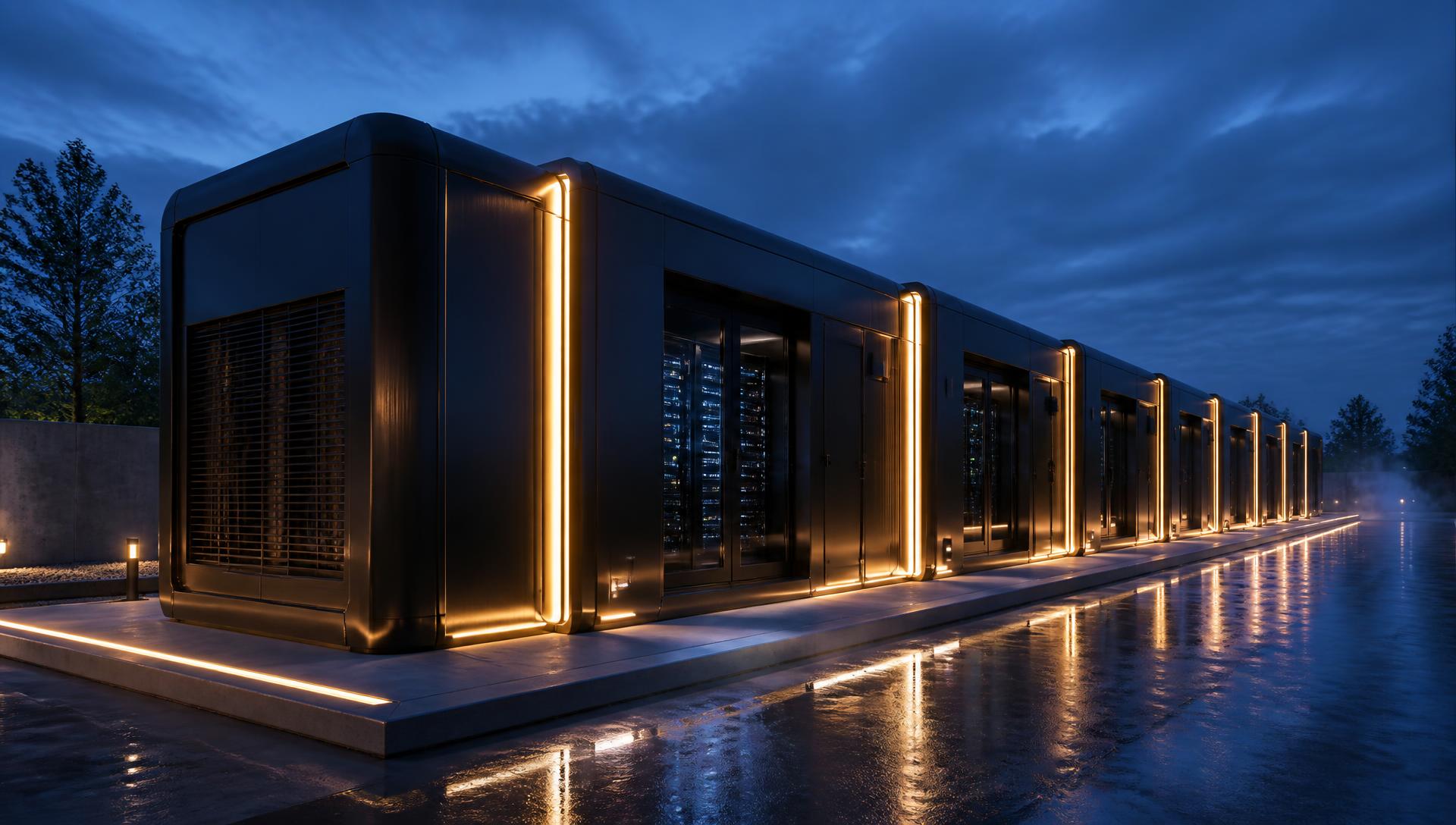
Rapid Deployment
Build AI infrastructure faster than traditional construction approaches.
Confidential — For Authorized Recipients Only
Strategic Solutions Center
Confidential Executive Briefing
SSC brings together the site, power, technology, customers, capital, partners and workforce needed to determine whether an AI infrastructure opportunity can become a sustainable economic asset.
This is the SSC Pain Point to Profit Center™ model applied to AI infrastructure.
01The Opportunity
An AI infrastructure project should answer a real problem, need, or economic opportunity. The starting point shapes everything that follows.
Nine common starting points for an AI infrastructure opportunity.
A school or campus wants students prepared for the AI economy.
Local users need computing power that is close, secure, and reliable.
A region wants new investment, jobs, and lasting tax base.
Researchers need capacity they cannot get today.
A site or building could support a productive new use.
Available power capacity could anchor a project.
Employers need trained talent and clear career pathways.
A company needs dedicated capacity for its own operations.
A community wants an asset that returns value locally.
Start Here
AI infrastructure is the power, cooling, security, and equipment needed to run artificial intelligence.
Power plus Internet plus Secure Technology plus AI Computing equals AI Infrastructure.
Who It's For
We shape each project around what your organization needs.
AI education, STEM and workforce pathways.
Research, education, workforce alignment and innovation.
Economic development, workforce alignment and infrastructure opportunities.
Training, certifications and career pathways.
Business attraction, workforce strategy and infrastructure development.
Technology, expertise, investment, careers and partnerships.
Capability
Give students and educators access to practical AI learning environments.
Connect education, credentials, projects, internships, apprenticeships, and employers.
Give faculty and students infrastructure for AI, cybersecurity, data analytics, engineering, agriculture, and interdisciplinary research.
Create environments where businesses can collaborate with universities, sponsor research, develop talent, and test approved AI applications.
Extend AI capability to schools, workforce organizations, governments, nonprofits, entrepreneurs, and community partners.
Explore sustainable revenue opportunities through research, workforce contracts, enterprise partnerships, approved compute utilization, intellectual property, commercialization, and other qualified uses.
Potential uses are illustrative. No revenue, financial return, or specific outcome is promised or guaranteed.
Choose Your Path
We start with what you are trying to accomplish. Then we look at the education, workforce, technology, funding, and infrastructure options that support that goal.
Schools • HBCUs • Universities • STEM Organizations
Prepare students, educators, and communities for opportunities created by AI, technology, and emerging industries.
Explore EducationCities • Counties • Economic Development Organizations
Explore how technology infrastructure can support jobs, workforce alignment, economic opportunity, and long-term community value.
Explore Community OpportunityProperty Owners • Businesses • Developers • Partners
Explore property, power, connectivity, customers, financing, and scalable AI infrastructure opportunities.
Explore InfrastructureThree entry points. One Strategic Solutions Center ecosystem.
How Do I Know Which One I Need?
Who are you?
What are you trying to accomplish?
Where are you today?
Answer the three questions above to see your next step.
02The Ecosystem
Infrastructure becomes valuable when the pieces around it work together.
One Project. Multiple Partners. One Coordinated Strategy.
Strategic Project Integrator
An AI infrastructure project requires more than technology. It requires the right site, power, capital, partners, customers, workforce, and project structure.
SSC serves as the strategic project integrator that helps bring these pieces together.
One Project. Multiple Partners. One Coordinated Strategy.
SSC
Identifies opportunities, qualifies sites, helps structure the project, and coordinates qualified partners — serving as the strategic project integrator.
Qualified Partners
Engineering, construction, financing, utility services, compute operations, technology, and education are delivered by qualified partners — not directly by SSC unless specifically provided.
SSC does not perform engineering, construction, financing, utility services, or compute operations directly unless those services are specifically provided by SSC.
Roles
Each partner does what they do best. No one replaces anyone else.
Education + STEM + Workforce Ecosystem
Strategy + Project Development + Infrastructure
Technology + Careers + Compute + Investment
Education + Jobs + Innovation + Economic Opportunity
Education partners lead education and workforce programming. SSC helps organize, develop and implement the infrastructure and project strategy supporting the ecosystem. Industry partners provide technology, expertise, career opportunities, customers, partnerships and investment where appropriate.
Partner Ecosystem
SSC sits at the center of the stakeholder map, translating between civic priorities, engineering realities, and capital requirements.
Education and Workforce Alignment
STEM2 Hub
STEM2 Hub supports the education and workforce-development component of the ecosystem, helping connect students, educators, schools, communities, and career pathways to the opportunities created by technology and infrastructure growth.
Learn About the Education EcosystemAbout SSC
SSC finds AI infrastructure opportunities, tests whether they work, and moves the good ones forward with the right partners.
Find opportunities where demand, power, and policy line up.
Test the site, the numbers, and the community return before anyone commits.
Bring partners together and scale the project as demand is proven.
Why SSC
We help plan the project and help build it. Every project should also give something back to the community.
Build AI infrastructure faster than traditional construction approaches.
Support jurisdictional governance, physical security, and secure AI operations.
Create long-term economic development, workforce opportunities, and digital resilience.
Bring together public, private, education, and enterprise stakeholders to accelerate AI infrastructure projects.
03Validation
Before significant resources are committed, SSC helps answer the questions that determine whether an opportunity is ready to move forward.
Build because the opportunity has been validated—not simply because the technology exists.
How It Works
Not every opportunity reaches deployment. Each step has to earn the next one.
What are you trying to accomplish?
What education, workforce, property, power and community resources already exist?
Is there real demand, leadership support, site feasibility, funding potential and a viable business model?
What is the right-sized starting solution?
Who are the required education, government, industry, infrastructure and capital partners?
Build the approved solution.
Expand only when demand and economics support expansion.
Validation Gate
Before major resources are committed, SSC helps determine whether the opportunity, location, demand, partners, funding and community objectives align.
Start small. Prove the model. Scale with demand.
How Do I Get Started?
SSC helps determine what you have, what you need, what is feasible, and what should happen next.
Tell us what your institution wants to accomplish.
Review the potential site, power, infrastructure, users, partners, funding, and compute demand.
Determine whether a Desktop Edge Node, Micro Edge, Enterprise Edge, or a phased network approach makes sense.
Develop the implementation, partnership, funding, workforce, community-benefit, and economic framework.
Begin with the right-sized infrastructure and expand as verified demand develops.
Before significant resources are committed, SSC helps answer the questions that determine whether an opportunity is ready to move forward.
Build because the opportunity has been validated—not simply because the technology exists.
Why Organizations Choose SSC
The old way focuses on the building. Our way focuses on the results the community and the budget need.
04Infrastructure
Start with what makes sense. Prove the value. Grow with verified demand.
How Do We Start?
Schools, universities and communities can begin with a right-sized solution and grow as education, workforce and infrastructure needs develop.
A small starting point supporting AI education, workforce exposure, experimentation and local compute.
Expanded institutional and community AI capability.
Larger infrastructure supporting institutional and commercial demand.
Connected locations creating a larger education, workforce, technology and economic ecosystem.
Desktop Edge NodeMicro EdgeEnterprise EdgeRegional Network
A Desktop Edge Node provides a smaller starting point for organizations that want to begin building AI education, workforce and compute capability without starting with a large infrastructure project. It is one possible pathway — not a requirement. Growth to later stages depends on demand, funding, power, partners and project feasibility.
Learn More About Each StageInfrastructure
Infrastructure grows only when the opportunity supports it. Not every project becomes a large data center, and that is by design.
Institutional need and real, validated demand.
Available power, property, connectivity and site feasibility.
Customers, funding and a viable business model.
Leadership support and community objectives.
Growth is opportunity-based and demand-driven. Each stage is evaluated on its own merits at the time it is considered. The technical details below support the story — they are there when you need them.
Start. Grow. Scale.
Start at the size that makes sense. Grow when the opportunity is ready.
A Desktop Edge Node, pilot, educational deployment, or research environment. Small enough to begin now.
Add modular capacity as education, workforce, research, customers, or community needs grow.
Expand into larger campus or regional infrastructure when demand, customers, power, and financing support it.
StartGrowScale
Not every project will progress through every stage. Project size depends on site qualification and market demand. Each stage is evaluated based on available power, customers, capital, and demand at the time.
In industry terms, Start typically means a Desktop Edge Node deployment such as a Desktop Edge Node. Grow typically means a micro or modular deployment. Scale covers multi-megawatt, campus, and regional infrastructure, measured in megawatts (MW) of IT load.
Each stage is delivered as prefabricated capacity blocks with the power, cooling, and network capacity sized to that stage. Adding a stage does not require replacing what is already installed.
Find Your Starting Size
Click through the three options to see what fits your situation. Not sure? That is exactly what an Opportunity Review helps you decide.
A small, self-contained unit you can plug in and use right away. Perfect for learning, teaching, and proving the model.
Where it works
K–12 AI lab • HBCU intro course • Community college pilot • Library makerspace
This is a good fit if you…
When to go bigger: You may be ready to grow when students or researchers need more compute than one node can provide.
Desktop Edge Node deployment. Typically under 50 kW of IT load. Ships as a single plug-and-play unit.
Plain Language
Projects are built in sections. Each section is added when it is needed, so a project grows without starting over.
One large build. It takes longer, costs more up front, and is often bigger than you need.
Add one section at a time. Pay for what you use, open sooner, and grow with demand.
Deployment Options
AI infrastructure that can start smaller and grow as demand grows. Begin with the size you need today and add more in clear steps, with no redesign and no wasted investment.
A starting size for pilot projects and city or county workloads.
Regional compute anchor with room for phased growth.
Production AI capacity for enterprise and research clusters.
Campus-grade deployment supporting dense training workloads.
Drag the timeline to see how one starting unit grows into a full AI campus, one stage at a time.
1 MW
Phase 1
Phase 2
Phase 3
Phase 4
Platform Capabilities
Power, cooling, internet, and security are planned together, not added later.
Purpose-built for accelerated training and inference workloads.
Low-latency fabric with redundant carrier and fiber paths.
Rack densities engineered for modern GPU deployments.
Add capacity later without redesigning the core facility.
Resilient distribution, backup, and utility coordination.
Liquid-ready thermal design tuned to density and climate.
Layered controls aligned to enterprise and public-sector standards.
Hardened perimeters, access control, and surveillance.
24/7 telemetry across power, thermal, and network systems.
Continuous visibility into efficiency and site conditions.
A reference design that grows from pilot to campus.
Sovereign Compute
Sovereign means local people stay in control. Together these three make AI systems a community can run, check, and trust.
Data and decisions stay inside the community's own legal boundaries.
Locally controlled buildings with strong security and controlled access.
Dedicated AI capacity you can see and manage, without waiting in line elsewhere.
05Economics
A validated asset with real users and sustainable economics can become a productive asset — and, over time, a profit center.
The Infrastructure Is the Asset. The Ecosystem Creates the Value.
Revenue opportunities vary by project. No financial return, revenue level or economic outcome is guaranteed. Nothing on this site is an offer to sell or a solicitation to buy any security.
From Cost Center to Productive Asset
Technology has traditionally been treated as an institutional expense.
Our model explores how properly structured AI infrastructure can support education while also creating opportunities for research, workforce alignment, enterprise partnerships, economic development, and sustainable revenue.
Illustrative framework only. No revenue or financial return is promised or guaranteed.
Economic Development
When education, workforce alignment, technology and infrastructure work together, communities can create stronger pathways to jobs, innovation, investment and long-term economic participation.
Local pathways into technology and infrastructure careers.
Research, experimentation and new local capability.
Reasons for partners and employers to invest locally.
Long-term community participation in the AI economy.
Outcomes vary by project, location and market conditions. Nothing here is a guarantee of jobs, revenue or economic results.
Community Profit Center
Start with available land, buildings, or power. Build in stages. Serve qualified customers. Create long-term value for the community.
Most communities receive taxes and temporary jobs when a large infrastructure project is built.
Our approach can go further.
We help schools, universities, counties, cities, and community partners explore ways to participate in the infrastructure asset itself.
This may create a new source of recurring revenue that can support education, workforce alignment, scholarships, public services, and other community priorities.
Own More Than the Location. Participate in the Value.
Step 1
The community may have land, an empty building, available power, or another site that could support a project.
Step 2
The project can begin with a smaller 2 MW or 4 MW deployment and expand as demand grows.
Step 3
A business, healthcare organization, government agency, university, or AI company pays to use the infrastructure or computing capacity.
Step 4
Revenue first covers power, operations, financing, maintenance, insurance, and required reserves.
Step 5
A defined portion of the remaining revenue may support schools, workforce programs, scholarships, public services, and future development.
The goal is not simply to host infrastructure. The goal is to turn infrastructure into an asset that continues producing value.
A smaller starting site for schools, universities, hospitals, businesses, or community locations.
Best for
A larger site that can support more customers, processors, and community programs.
Best for
A larger infrastructure asset that may support several customers and become part of a wider regional AI ecosystem.
Best for
Start small. Prove the model. Grow when the customers and power are ready.
Customers may pay each month to use the powered infrastructure.
Customers may pay to use AI processors, data storage, or computing capacity.
Qualified tenants may reserve capacity through multi-year agreements.
Landowners, schools, counties, or project entities may receive agreed lease or participation payments.
Projects may also create tax revenue, workforce funding, vendor opportunities, and community-benefit payments.
Power does not create revenue by itself. Revenue is created when available power, infrastructure, and customer contracts work together.
A community profit center is an income-producing asset that helps generate recurring value for local priorities.
It may help support
Instead of receiving only a one-time benefit, the community may receive continuing value from the asset.
A project should not make money while leaving the community to carry the cost.
Before a project moves forward, the community should understand how it may affect:
True profit means the project earns revenue without pushing hidden costs onto families, schools, or public systems.
Building AI infrastructure is only one part of the opportunity.
Communities also need students, educators, workers, and local leaders who understand the new technology economy.
STEM2 Hub supports the education and workforce-development side of the ecosystem by helping connect education, career awareness, educator development, workforce preparation, and community learning to the larger infrastructure opportunity.
Infrastructure creates the platform. Education helps the community participate in the opportunity.
Infrastructure Strategy and Project Development
Strategic Solutions Center helps communities evaluate opportunities, organize qualified partners, structure projects, and move AI infrastructure initiatives toward implementation.
Education and Workforce Alignment
STEM2 Hub supports the education and workforce-development component by helping connect educators, students, schools, community partners, and career pathways to the growing technology economy.
AI awareness, educator support, workforce preparation, student pathways, community learning, and stronger connections between education and industry.
Community Value Scenario Tool
See how project size, customer payments, costs, and community participation may work together.
This tool provides a simple planning example. It does not promise financial results.
Illustrative Scenario — Not a Guarantee
Business model: Community participation model — a share of what remains after project costs on a hosted site. This is calculated differently from the single-site ownership model in the ROI Calculator and from the Sustainability Partners package.
Financial outcomes depend on project size, power availability, utilization, compute contracts, financing, operating costs, market conditions, and other project-specific factors.
Project SizeMW means megawatts. It tells us how much electrical capacity may be available for the infrastructure.
MW means megawatts. It tells us how much electrical capacity may be available for the infrastructure.
Estimated customer payment per kilowatt each month. Illustrative planning assumption.
This is the portion of the available infrastructure that customers agree to pay for.
This may include power, operations, financing, insurance, maintenance, and reserves.
This is an example of the portion of remaining project revenue that may be directed toward community priorities.
Available Infrastructure
2 MW
2,000 kW of potential capacity
Illustrative Example
Estimated Gross Contract Revenue
$768,000
Customer payments each year, before project expenses
Illustrative Example
Estimated Distributable Revenue
$268,800
What may remain after 65% project costs
Illustrative Example
Illustrative Community Value
$53,760
20% of what remains, each year
Illustrative Example
Illustrative 30-Year Community Value
$1,612,800
This does not include inflation, annual rate increases, changes in operating costs, equipment replacement, refinancing, taxes, contract changes, or periods without a paying customer.
How the money moves
Gross revenue is not the same as profit. Project costs and obligations must be paid before money is distributed.
Move the sliders to see how the yearly amount could be shared. Percentages should add up to 100%.
May include educator development, student learning, AI literacy, workforce programs, scholarships, certifications, internships, and other approved education priorities.
Total: 100%
Education and Workforce Ecosystem
A portion of approved community value may help support educator development, student programs, AI literacy, workforce preparation, certifications, internships, scholarships, and other locally approved education priorities.
Education and workforce-development support may be coordinated with STEM2 Hub and other qualified education partners based on the needs of each community.
Final use of community funds would be decided through written agreements, local governance, and approved community priorities.
Illustrative community value may support education and workforce priorities, including AI literacy, educator development, student programs, scholarships, certifications, and career pathways.
The use of project funds would be determined through written agreements, approved governance, and local community priorities.
Assumptions used in this example
These assumptions belong to this example only. Do not compare these figures with numbers from a different business model elsewhere on this page — each model is calculated differently.
These figures are planning estimates only. Actual project economics require site qualification, engineering, power review, customer agreements, financing, and final underwriting. These figures are simple planning illustrations only. They are not financial promises, investment projections, lease offers, or guarantees of revenue. Actual results depend on land, available power, customer demand, equipment, financing, construction costs, operating costs, legal structure, utility agreements, project ownership, and final contracts. Every project must complete technical, financial, legal, environmental, utility, and community review before moving forward.
You do not have to begin with a massive data center.
A school, university, county, city, healthcare system, business, nonprofit, or property partner may be able to begin with a smaller project and grow in stages.
See the Community Review ProcessWe help communities move from simply hosting infrastructure to participating in the value it creates.
Start small. Build responsibly. Grow with demand. Create value that stays in the community.
Before the detailed numbers, here is the whole concept. Revenue is presented as a potential outcome of a properly structured and validated project.
Create a right-sized, validated project.
Support education, institutions and customers.
Revenue is a potential outcome, not a promise.
Value can return to education and local priorities.
Package Offering
A simple way to pair the everyday needs a community already has with an AI compute deployment that can help pay for them.
Illustrative Scenario — Not a Guarantee
Business model: Bundled municipal program model (SPV) — community infrastructure paired with one AI compute deployment. These figures use different assumptions than the ROI Calculator or the Community Value Scenario Tool and should not be compared side by side.
Financial outcomes depend on project size, power availability, utilization, compute contracts, financing, operating costs, market conditions, and other project-specific factors.
The simple formula
$700M
Of community needs a city or county already has
$50M
AI compute deployment, built one time
~$150M / year
A yearly revenue stream that may support the SPV
Important: the $50M is what it costs to build the AI compute deployment. It is not the yearly cash flow. The yearly number is separate, and it repeats each year the system is running and contracted.
Water
Power
Housing
Compute
Water, Power, Housing, and Compute Bundle
$700M
The community projects a city or county already needs.
AI Compute Deployment
$50M
A one-time build cost for the starting AI compute system.
Total Starting Program
$750M
The two pieces added together.
Revenue the Deployment May Generate
$150M / year
Money coming in each year, not a one-time amount.
3.0×
Yearly revenue compared to the $50M build cost
21.4%
Yearly revenue compared to the $700M infrastructure bundle
Not all of the $150M has to go toward paying down debt. Under the planning split we use today, it may be shared about evenly.
$75M / year
Community and customer side
Merchant activity, cashback and incentives, and money that circulates back through the local economy.
$75M / year
Debt service support
Payments that help support the SPV and the financing behind the program.
Assumptions used in this example
These assumptions belong to this example only. Do not compare these figures with numbers from a different business model elsewhere on this page — each model is calculated differently.
Illustrative scenario — not a guarantee. These figures are planning assumptions used to explain how the package could work. They are not financial promises, investment projections, or guarantees of revenue. Actual results depend on land, available power, customer demand, equipment, financing, construction and operating costs, legal structure, utility agreements, ownership, and final contracts. Every project must complete technical, financial, legal, environmental, utility, and community review before moving forward.
Outcomes Estimator
Pick a size, set a few simple choices, and see what community, workforce, and economic outcomes could look like.
Illustrative Scenario — Not a Guarantee
Business model: Outcome planning model — illustrative community, workforce, and economic estimates for a chosen deployment size. Calculated differently from the ROI Calculator and the Community Value Scenario Tool.
Financial outcomes depend on project size, power availability, utilization, compute contracts, financing, operating costs, market conditions, and other project-specific factors.
One small system in a classroom, lab, or office. Low cost, quick to set up.
How many locations of this size you are considering.
The share of remaining project revenue that may go to community priorities.
How many years you want to look ahead.
Community
$11,250
Illustrative community value each year
25% of what may remain after project costs
$112,500
Over 10 years
Before inflation, rate changes, or contract changes
Workforce
250
Learners reached each year
Students and community members touched by programs
40
Training seats each year
Certificates, internships, and skills programs
1
Ongoing local roles supported
Operations, maintenance, and program staff
400
Training seats over 10 years
Simple planning total, not a commitment
Economic
$73,000
Local economic activity each year
Community value plus local spending from supported roles
$730,000
Over 10 years
Illustrative planning estimate only
Assumptions used in this example
These assumptions belong to this example only. Do not compare these figures with numbers from a different business model elsewhere on this page — each model is calculated differently.
These figures are planning illustrations only. They are not financial promises, investment projections, job guarantees, or offers. Actual outcomes depend on land, available power, customer demand, equipment, financing, construction and operating costs, legal structure, utility agreements, project ownership, and final contracts. Every project must complete technical, financial, legal, environmental, utility, and community review before moving forward.
ROI Calculator
Move the sliders to change the size and cost of a project. The numbers update right away, so you can see what it costs, when it pays for itself, and how many jobs it could bring. You can download the results to share.
Illustrative Scenario — Not a Guarantee
Business model: Single-site AI infrastructure ownership model — one project, built and operated on its own capacity, revenue, and costs.
Financial outcomes depend on project size, power availability, utilization, compute contracts, financing, operating costs, market conditions, and other project-specific factors.
Project Size
How big the site is. Example: 2 MW.
How much computing power the site holds. 1 MW is about the power used by 400 homes.
Estimated Capital Cost
What it costs to build. This is specific to your project.
What it costs to build one unit of the site, start to finish.
Estimated Compute Utilization
How much of the site customers actually use. This is specific to your project.
The share of the site that customers are actually using.
Estimated Revenue
Money coming in. Calculated from the assumptions you choose.
What customers pay each month for a small slice of the site.
How much prices go up each year, like rent going up.
Estimated Operating Cost
Money going back out to run the site. Calculated or entered as an assumption.
Money that goes back out for power, staff, repairs and insurance.
Scenario Settings
How far ahead to look, and your local hiring goal.
How many years this estimate covers.
The share of jobs you want to give to people who live nearby.
Assumptions used in this scenario — review before the results
These assumptions belong to this example only. Do not compare these figures with numbers from a different business model elsewhere on this page — each model is calculated differently.
Project economics only. Community benefit is shown separately below.
One-time cost to build the site.
Money customers pay in the first year.
Money spent to run it in the first year.
What may be left after 10 years, once the build cost is paid back.
How long until the build cost is earned back.
Total gain compared to the build cost.
Money in vs. money spent, year by year
Grey bars below the line mean the project is still paying back what it cost to build. Gold bars above the line mean it has earned back more than it cost.
Shown separately from project revenue. These are community outcomes, not money paid to the project owner.
These figures are planning estimates only. Actual project economics require site qualification, engineering, power review, customer agreements, financing, and final underwriting.
06Impact
When the asset performs, the community gains education, workforce pathways, research capacity, entrepreneurship, jobs, and lasting opportunity.
Build the Workforce. Build the Infrastructure. Build the Community.
STEM2 Hub supports education, STEM learning, career exposure, and workforce alignment connected to AI infrastructure projects.
STEM2 Hub is an education and workforce ecosystem partner. STEM2 Hub does not own, finance, operate, guarantee or develop SSC AI infrastructure.
Education is the front door. Infrastructure is the engine. Community opportunity is the outcome.
Education
AI infrastructure should do more than house technology. It should create opportunities for students, educators, workers, institutions, and communities.
AI exposure, STEM learning, career pathways and hands-on experiences.
Professional development, classroom resources and emerging technology exposure.
Research, workforce alignment, innovation and partnership opportunities.
Local workforce pipelines, economic development and long-term community value.
The Journey
Education creates the talent. Workforce alignment prepares the talent. Infrastructure creates a place for that talent and technology to grow.
Early exposure and STEM learning.
Degrees, research and innovation.
Skills, certifications and practice.
Careers, employers and technology partners.
Investment, jobs and long-term community value.
Education & Workforce Ecosystem
AI infrastructure can create more than computing capacity. It can become a platform for education, workforce alignment, career exposure, certifications, internships, and community opportunity.
Through education and workforce partnerships such as STEM2 Hub, communities can connect infrastructure investment with pathways for students, teachers, workers, and families.
Connect students to AI, technology, engineering, and emerging careers.
Build pathways to technical and nontechnical jobs connected to the digital economy.
Help students understand the careers being created around AI infrastructure.
Connect economic development with education and local opportunity.
STEM2 Hub is an education and workforce ecosystem partner. STEM2 Hub does not own, finance, operate, guarantee, or develop the AI infrastructure described on this site.
Education AI Infrastructure Pathway
Your institution does not have to start with a massive data center to participate in the AI economy.
SSC helps educational institutions identify the right-sized starting point based on their goals, site, power, students, research needs, workforce opportunities, community needs, funding strategy, and potential compute demand.
Best for
Schools, STEM centers, individual university departments, workforce centers, innovation labs, smaller colleges, agricultural extension locations, and pilot programs.
Purpose
Create an affordable and practical entry point into AI infrastructure.
Potential uses
Start with a focused use case. Measure the results. Build demand before expanding.
Explore a Desktop Edge NodeBest for
HBCUs, universities, community colleges, research campuses, workforce ecosystems, municipalities, and larger educational partnerships.
Purpose
Move from an individual AI program to a shared institutional AI asset.
Potential applications
Grow when demand, partnerships, power, funding, and utilization justify expansion.
Explore a Micro SiteBest for
University systems, major universities, research institutions, regional partnerships, public-private partnerships, and multi-campus ecosystems.
Purpose
Create a larger AI infrastructure platform capable of supporting institutional and regional demand.
Potential applications
Scale infrastructure as verified demand and economic opportunity grow.
Explore an Enterprise SiteYou don’t have to build everything at once. Build what you need. Prove the value. Scale with demand.
The Education AI Infrastructure Network
A university can become more than a user of AI. It can become a trusted regional hub connecting education, research, workforce development, industry, government, and community partners.
Smaller Desktop Edge Node sites can connect into larger Micro Edge or Enterprise Edge environments as the ecosystem develops.
The Education Model
Infrastructure creates the platform. Education helps the community participate in the opportunity.
Help students, educators, and communities understand AI and emerging technology.
Create education, certification, workforce, research, and hands-on learning opportunities.
Connect learning to internships, careers, employers, entrepreneurship, and emerging industries.
Strengthen the local workforce, institution, technology ecosystem, and economy.
LearnTrainWorkGrow
We start with one question: what are you trying to accomplish for your students, institution, workforce, and community? Infrastructure is a tool that may support that goal. STEM2 Hub and other education partners support education and workforce pathways. They do not own, develop, finance, guarantee, or operate SSC infrastructure projects.
Community Impact
These are sample targets. Real project numbers and stories will be added here as sites open.
0M+
Projected regional investment activity
0+
Construction, operations, and adjacent roles
0 MW
Planned capacity pipeline
0
Institutional workforce partnerships
Local compute for imaging, diagnostics, and clinical AI workloads.
Research capacity that keeps discovery and IP in-region.
Training pathways and infrastructure literacy for the local workforce.
Blended capital structures aligning civic and investor returns.
Coming Soon
Deployment stories coming soon.
Available
Model capacity, payback, and community outcomes — now live.
Measure What Matters
Success should be measured by more than the number of people trained or the amount of technology installed.
Measure what happens because the infrastructure exists.
Don’t just measure activity. Measure outcomes.
Your Starting Point
Start With What Makes Sense.
Desktop Edge Node. Micro Edge. Enterprise Edge.
· Start. Prove. Grow. Scale.
Whether you are a school, HBCU, community college, university, workforce organization, or community partner, SSC can help determine the appropriate starting point.
You do not have to know how many servers you need. You do not have to know how many megawatts you need. You do not have to have the entire project figured out.
Start with the opportunity. We will help you evaluate the pathway.
We help governments, schools, utilities, developers, and investors evaluate, structure, and advance AI infrastructure projects. We turn complex data center and compute decisions into clear, actionable plans.
AI Infrastructure Asset Partners is the parent organization behind Strategic Solutions Center. It brings together capital, engineering, and community-focused partners to build responsible AI infrastructure.
We do not just build facilities. We identify the right opportunity, evaluate risks and returns, and advance projects with capital, partners, and local stakeholders aligned from day one.
Yes. Projects can start smaller, sometimes below one megawatt, and grow as demand grows. This lowers upfront risk and lets communities benefit early.
Sovereign compute means keeping data, AI models, and critical computing power within a defined jurisdiction or organization. It supports security, local control, and long-term economic resilience.
Projects can create local jobs, generate tax revenue, support workforce training, and share value through structured community benefit agreements. Our Community Value Scenario Tool shows how these pieces can add up.
STEM2 Hub is our strategic partner for education and workforce alignment. It helps connect AI infrastructure projects with training programs, schools, and career pathways so local talent benefits directly.
Timelines vary by site, permitting, and power availability. A smaller pilot can move quickly, while larger facilities may take years. Our process is designed to find the fastest responsible path for each project.
Request an Opportunity Review or request a site assessment through the contact section. We will review your location, goals, and constraints and recommend a clear next step.
Still have questions? Request an Opportunity Review and we will walk through your specific situation.
Get Started
Tell us about your jurisdiction, campus, or portfolio and we will map the fastest responsible path to operating capacity.